
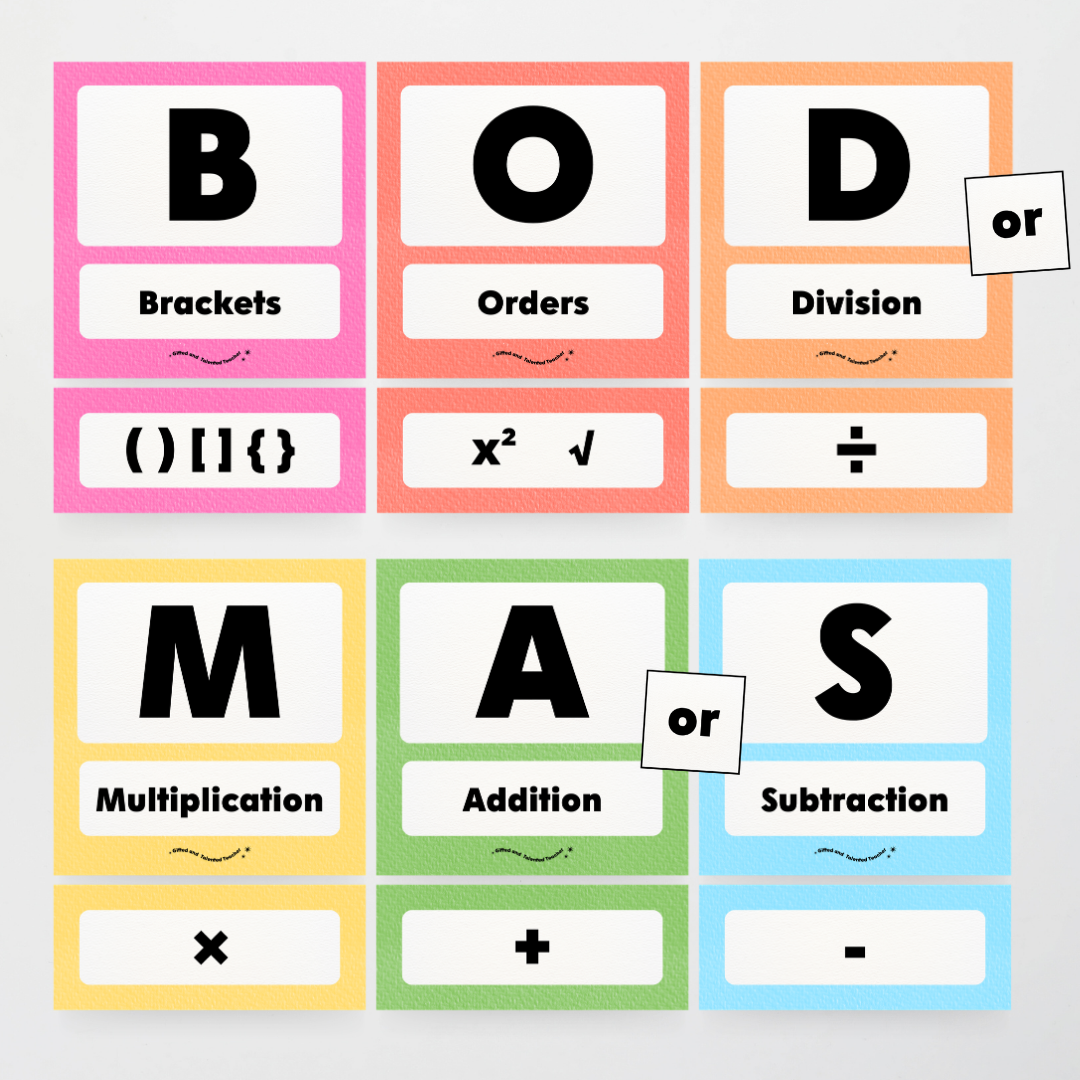
If you have ever taught the order of operations, you will know that teachers quickly notice something confusing: there are many different acronyms used around the world.
Students might hear BODMAS, BOMDAS, PEMDAS, or even GEMS depending on the curriculum, country, or teacher preference.
With this knowledge, all order of operations acronym classroom wall displays are available at Gifted and Talented Teacher in all classroom themes. Click here to explore the various options.
The good news is that all of these acronyms are trying to describe the same mathematical principle: the order in which operations should be completed when solving a numerical expression.
Understanding this structure helps ensure that everyone arrives at the same answer when solving the same problem.

Featured: BODMAS Order of Operations - Rainbow Classroom Decor
Why Order of Operations Exists
Order of operations provides a universal structure for calculations. Without it, the same equation could produce multiple answers depending on how someone solved it.
For example: 8 + 4 × 5
If we solved the problem from left to right we would get: (8 + 4) × 5 = 60 incorrect answer
But according to the order of operations we complete multiplication before addition, giving us: 8 + (4 × 5) = 28 correct answer
This consistent structure ensures mathematics remains logical, predictable and shared across the world.
The Many Acronyms for Order of Operations
All order of operations acronyms are available at Gifted and Talented Teacher in all classroom decor themes. Click here to explore the various pages.

Featured: PEMDAS Order of Operations - Rainbow Classroom Decor
Across different education systems, teachers use different acronyms to help students remember the order.
Common examples include:
BODMAS: Brackets, Orders (powers, indices), Division, Multiplication, Addition, Subtraction
BOMDAS: Brackets, Orders, Multiplication, Division, Addition, Subtraction
PEMDAS / PEDMAS: Parentheses, Exponents, Multiplication, Division, Addition, Subtraction
PIMDAS / PIDMAS: Parentheses, Indices, Multiplication, Division, Addition, Subtraction
Although the acronyms look different, they all describe the same mathematical order.
The key idea is:
- Brackets / Parentheses
- Powers / Orders / Indices / Exponents
- Multiplication and Division
- Addition and Subtraction
The Problem With Traditional Acronyms
One of the most common misconceptions occurs when students believe:
- Multiplication must always come before division, or
- Addition must always come before subtraction
In reality:
- Multiplication and division have equal priority
- Addition and subtraction have equal priority
This means they are completed from left to right as they appear in the expression.
For example: 20 ÷ 5 × 2
This is solved left to right, not multiplication first.
20 ÷ 5 = 4
4 × 2 = 8
Many acronyms unintentionally create confusion because the letters suggest a strict order where one does not actually exist.
A Simpler Approach: GEMS / GEMA
Some educators now prefer the acronyms GEMS or GEMA because they more accurately reflect how operations work.
GEMS: Groups, Exponents, Multiplication and Division, Subtraction and Addition

GEMA: Groups, Exponents, Multiplicative Operations, Additive Operations

The key improvement is that multiplication and division are grouped together, and addition and subtraction are grouped together.
This removes the need for students to memorise that some operations share equal value.
Instead, students understand that they simply:
- Solve groups first
- Apply exponents
- Work through multiplication and division from left to right
- Finish with addition and subtraction from left to right
This approach often leads to stronger conceptual understanding, rather than memorising a rigid sequence.
Helping Students Develop Understanding
Rather than focusing only on a mnemonic, it can be helpful to emphasise that order of operations is about mathematical structure, not just remembering a phrase.
Encouraging students to:
- Identify groups first
- Recognise exponents
- Work left to right within operation pairs
helps them build confidence and accuracy when solving expressions.
Whether your classroom uses BODMAS, PEMDAS or GEMS, the goal remains the same: helping students understand why operations are performed in a particular order.


Leave a comment
This site is protected by hCaptcha and the hCaptcha Privacy Policy and Terms of Service apply.