
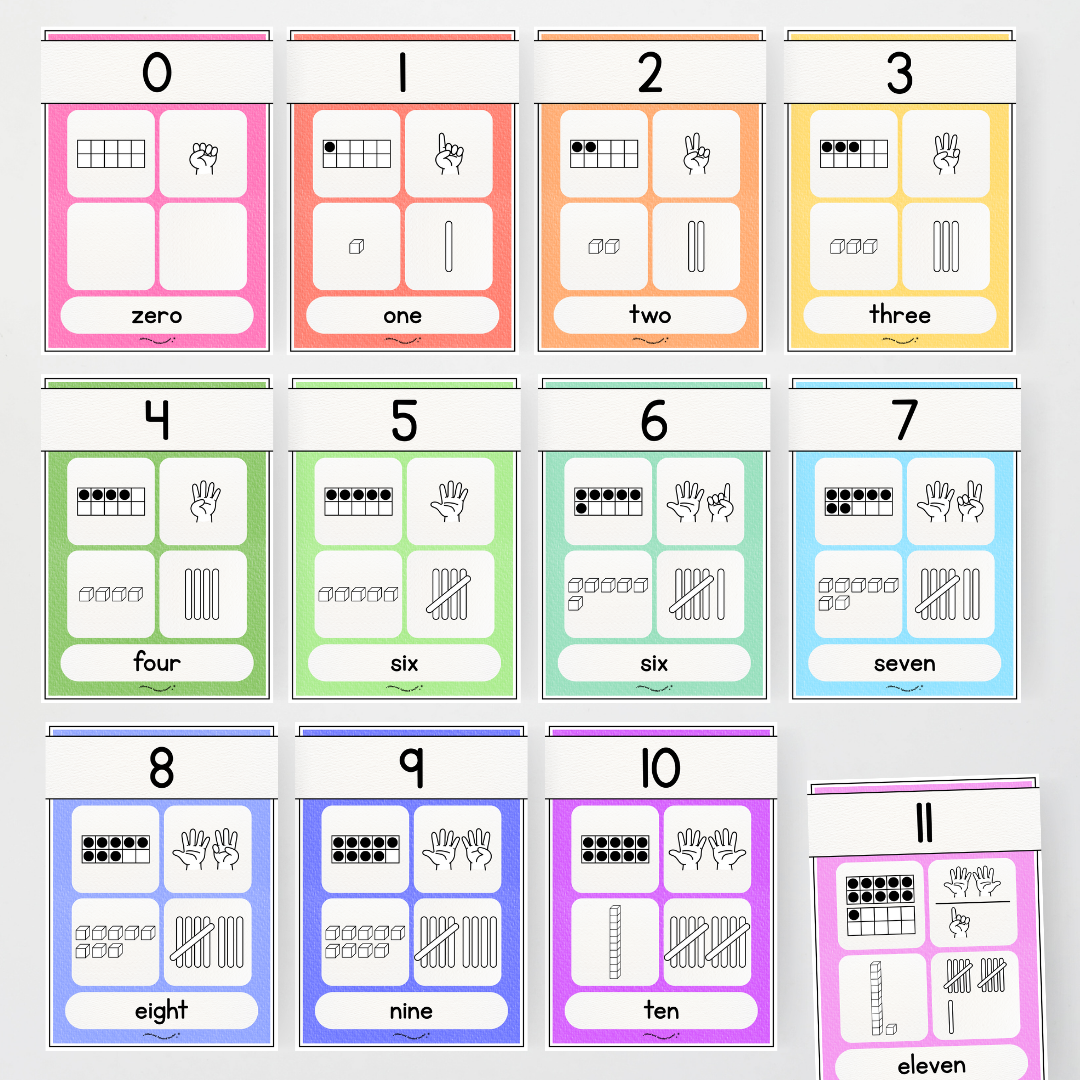
In the early years of mathematics, one of the most important foundations students develop is number sense. Before students can confidently add, subtract, multiply or divide, they need to understand what numbers actually represent.
Number sense posters that display numbers in multiple forms such as numerical form, word form, tallies, fingers, ten frames and MAB representations provide a powerful visual support for developing this understanding.
Click here to view Number Sense Posters in all Australian state and territory fonts, KG Primary Penmanship and Sassoon Primary font in all Gifted and Talented Teacher classroom decor themes.

Featured: Number Sense Maths Posters 0-30 - Rainbow Classroom Decor
When students see numbers represented in different ways, they begin to recognise that a number is not just a symbol, but a quantity that can be represented, grouped and interpreted in multiple forms.
What Is Number Sense?
Number sense refers to a student’s flexible understanding of numbers and quantities. It includes the ability to:
- Recognise numbers and quantities
- Understand that numbers represent amounts
- Subitise small quantities
- Compare numbers
- Decompose and compose numbers
- Move between different representations of the same number
Research consistently shows that early number sense is one of the strongest predictors of later mathematical achievement.
Students who develop a strong conceptual understanding of numbers in the early years are better prepared for later learning in place value, operations, fractions and algebra.
Why Multiple Representations Matter
Young learners do not automatically connect a numeral such as 7 with the idea of seven objects. This connection must be built through experience, modelling and visual supports.
Displaying numbers using multiple representations helps students understand that different visuals can represent the same quantity.

Seeing these representations together supports students in building strong mental connections between symbol, language and quantity.
Key Representations That Support Number Sense
Numerical Form: The numeral (for example, 5 or 12) is the symbolic representation of a number.
Word Form: Number words (such as five, twelve, or twenty) support both literacy and numeracy development.
Connecting numerals to written number words helps students build links between spoken language, written language and mathematical symbols.
Tallies: Tally marks introduce students to the idea of counting in groups.
Because tallies group numbers in fives, they also provide an early introduction to skip counting and grouping strategies, which later support multiplication and efficient counting.
Fingers: Finger representations are a powerful and natural way for young learners to represent numbers.
Research shows that finger-based representations support early number development, as fingers allow children to physically model quantities and build connections between numbers and real-world amounts.
Ten Frames: Ten frames are one of the most widely used visual tools for developing number sense.
They help students:
- Recognise numbers without counting (subitising)
- Understand part–whole relationships
- See how numbers relate to ten
- Develop early addition and subtraction strategies
MAB Representation (Base Ten Blocks): Multi-Base Arithmetic Blocks (MAB) help students visualise numbers using ones, tens, hundreds and thousands.
As students progress, MAB materials support the development of place value understanding, which is essential for later arithmetic.

Supporting Number Sense in the Classroom
Number sense posters can play an important role in a classroom environment by providing consistent visual references.
Displaying numbers using multiple representations helps students:
- Quickly recall quantities
- Make connections between representations
- Build confidence when counting and comparing numbers
- Develop flexible thinking about numbers
Over time, these visual supports contribute to a classroom where numbers are visible, meaningful and connected.
When students repeatedly see numbers represented in different ways, they begin to understand that numbers are more than symbols they are quantities that can be represented, grouped and interpreted in many forms.


Leave a comment
This site is protected by hCaptcha and the hCaptcha Privacy Policy and Terms of Service apply.